


Protect signals with a secret key
Require a matching secret in your alert messages and diagnose missing or incorrect keys.
Legacy subscriptions: existing Advanced and Professional subscriptions retain their documented access. Check the subscription shown in Portal before changing plans.
Signal Authentication checks that the secret= value in an alert message matches the key saved in PineConnector Portal. When it is enabled, a missing or incorrect key prevents the signal from being forwarded to MetaTrader.
Your License ID selects the destination. Your secret key is a separate value used to authenticate the signal. Do not use one in place of the other.
Before you enable it
Section titled “Before you enable it”The published guide documents support from PineConnector EA v3.15. Check the feature’s availability in your subscription and the version on the intended connection.
Choose your own secret and keep it private. The published guide recommends at least eight characters and a mixture of character types. Use the format accepted by Portal; do not copy a sample key from a guide as your real key.
Configure the key in Portal
Section titled “Configure the key in Portal”- Open Signals in PineConnector Portal.
- Select Signal Modifier.
- Find Signal Authentication and enter your chosen Secret Key.
- Turn authentication On and select Save when your affected alerts are ready to use the same key.
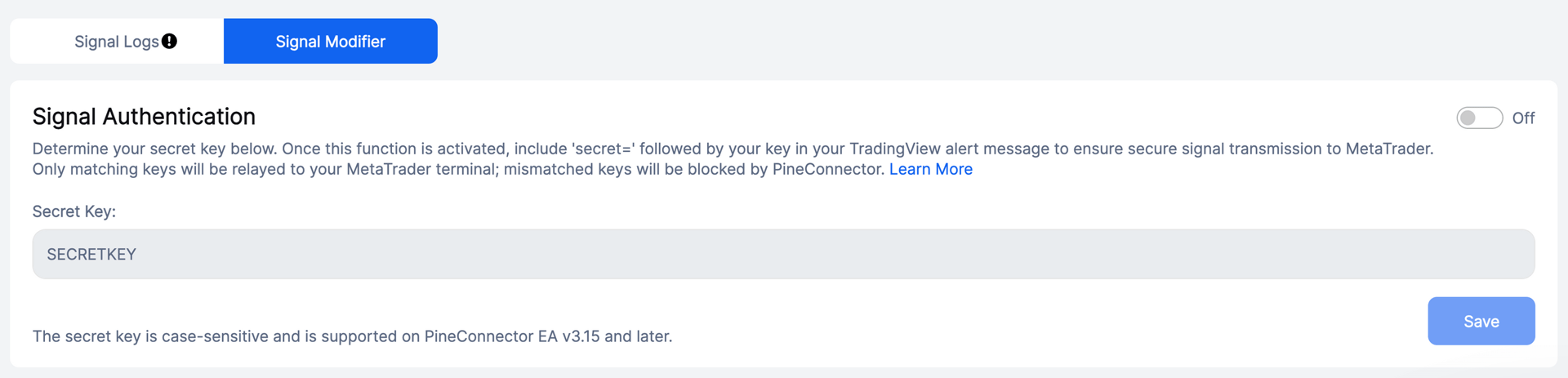
The key is case-sensitive. A capital letter, lowercase letter or extra character makes a different value.
Add the key to your alert message
Section titled “Add the key to your alert message”Add secret=YOUR_SECRET_KEY to the PineConnector alert message, replacing the placeholder with the exact key saved in Portal. Do this in TradingView, not in a form on this documentation site.
This example requests a buy of 0.01 lots using the current explicit-volume syntax. Replace the broker symbol and use a permitted demo size. The secret is a separate authentication value; it does not change trade size.
If you maintain older risk=-based alerts, retain their reviewed sizing and EA settings, and add only the matching secret= field. Legacy parameter guidance.
If your message comes from Pine Script, add the parameter to the generated message. Recreate the TradingView alert after changing the script or its inputs so the alert uses the updated snapshot.
Verify authentication and the trade separately
Section titled “Verify authentication and the trade separately”Use a demo account and the test-alert workflow.
- Confirm the alert uses the intended License ID and matching secret.
- Check the signal’s result in the Signal Log.
- If it passes authentication, check MetaTrader for the expected order.
- Confirm the account, symbol, direction, volume and targets, with no unintended duplicate.
Passing the secret-key check does not guarantee execution. Other syntax, EA settings or broker rules can still prevent the order.
Missing or incorrect key
Section titled “Missing or incorrect key”| Signal Log result / situation | What to check |
|---|---|
Authentication is on, but no secret= was sent |
Add the parameter to the alert that actually fired. |
| The secret does not match | Compare the key with Portal exactly, including case and extra characters. |
| The message still uses an old key | Update that alert; changing Portal alone does not change it. |
| A script was updated but the alert still sends the old value | Recreate the alert with the updated script/inputs. |
The published guide says missing and incorrect keys are withheld and recorded in the Signal Log. Correct the source of the message before sending another demo test. Do not disable authentication merely to make an unexplained failure disappear.
Change a secret safely
Section titled “Change a secret safely”Identify every alert that uses the old key, prepare their replacement messages, and coordinate the Portal change with those alerts. Confirm the new key with a demo test before returning to the intended automation.
If the old key was shared accidentally, replace it rather than continuing to use it. Never post either key when asking Support to investigate; share the error and a redacted example instead.
Watch the walkthrough
Section titled “Watch the walkthrough”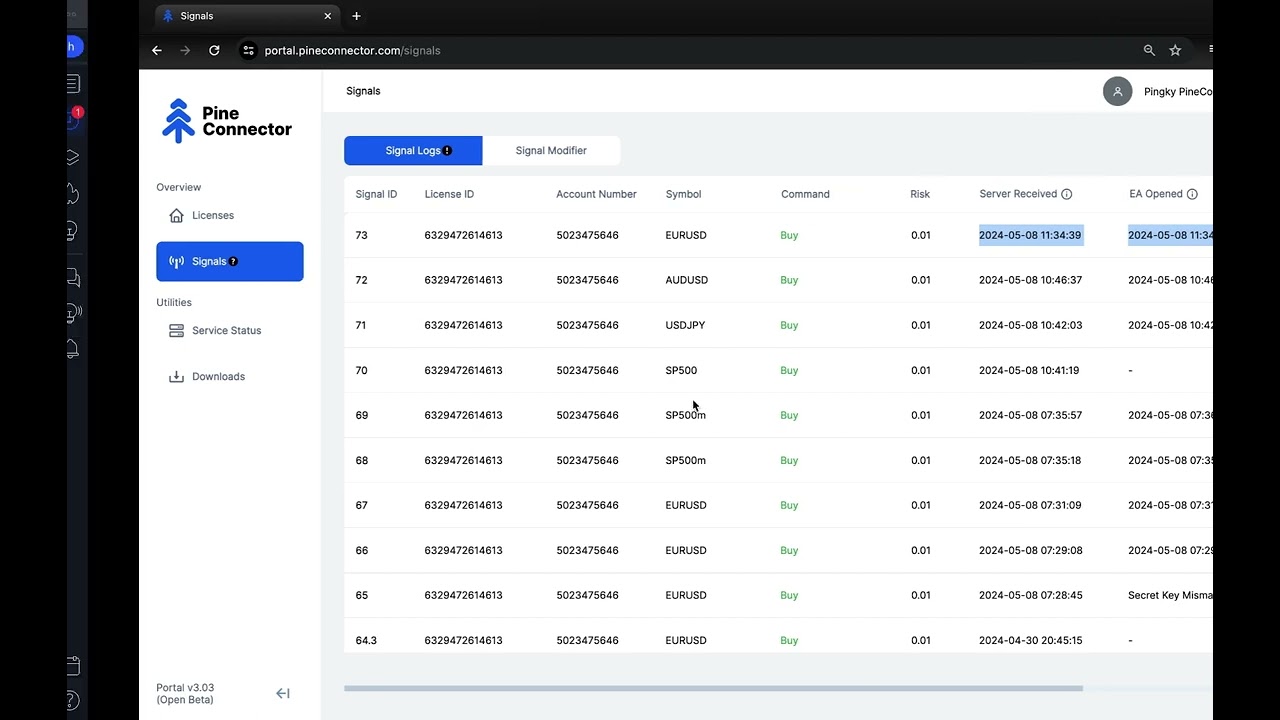
Set up Signal Authentication
For message structure, use PineConnector Syntax. For a signal that stops elsewhere in the workflow, use Missing signals.