


Test your setup
Check connection messaging, then send and verify one TradingView trade on your demo account.
Your account should now be connected, with its License ID copied from Connect MT5. This stage checks connection messaging first, then follows one demo order from TradingView to the broker.
| Check | What it establishes |
|---|---|
| Connection test | Whether the fixed test message reaches the connected setup and produces the expected processing record. |
| TradingView demo order | Whether the alert condition, message, webhook, routing and broker order work together. |
1. Check connection messaging
Section titled “1. Check connection messaging”Paste the copied License ID, review the fixed LicenseID,test,test message and select Send connection test once.
Send a connection test
Check the connection using the fixed message below.
Find the intended ID in Portal → Connections. Check every account using it. This widget does not save what you enter.
- Destination
https://webhook.pineconnector.com- Message
LicenseID,test,test
A connection check, not a broker trade. Your License ID is sent only when you press Send.
Open Portal → Bridge and look for the matching test by time and account. Inspect its processing result. A browser response saying sent or accepted does not, by itself, confirm that the terminal processed it.
If the browser cannot confirm delivery, check Bridge before trying again. If the connection test needs investigation, use Missing signals or EA Errors.
This check does not verify a broker trade or TradingView’s configuration. Continue with the separate order test below.
2. Find the broker symbol and prepare the message
Section titled “2. Find the broker symbol and prepare the message”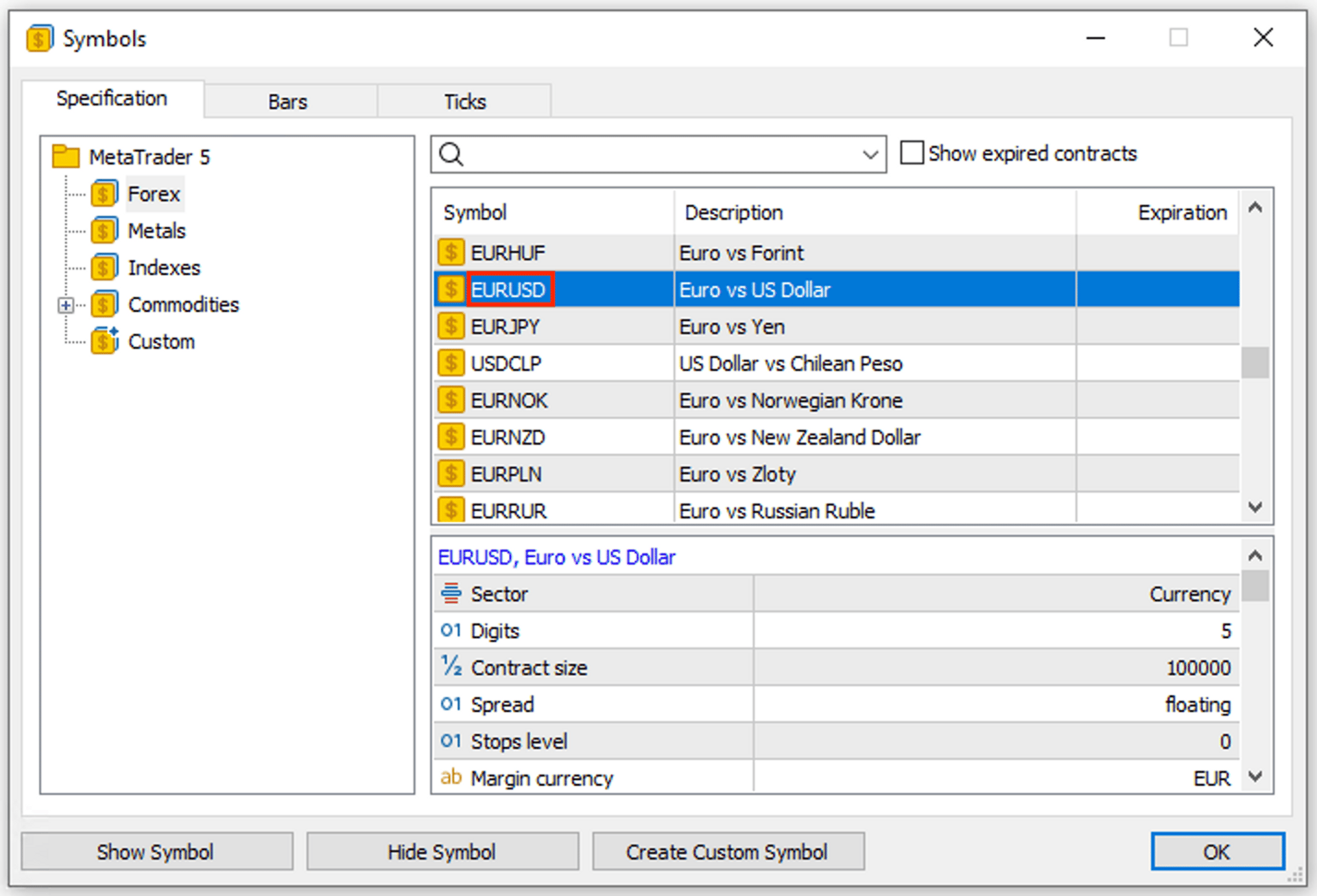
Check the instrument’s permitted lot size and trading session. It must be open for trading when you expect the demo order. If your broker’s EURUSD market is closed, wait or use another open demo instrument whose exact name and permitted size you have checked.
This example requests a buy of 0.01 lots on EURUSD, without SL or TP. Replace the License ID and broker symbol. Change 0.01 only if your demo account requires a different permitted volume.
If Signal Authentication is enabled, use the form below and replace YOUR_SECRET privately in TradingView. Never put the secret into the docs’ License ID field or connection-test tool.
3. Open TradingView’s alert editor
Section titled “3. Open TradingView’s alert editor”- Open a normal price chart receiving live, positive quotes, such as a liquid BTCUSD chart.
- Select the Alerts alarm-clock icon in the right-hand toolbar.
- Select + or Create alert. You can also use AltA on Windows or OptionA on Mac.
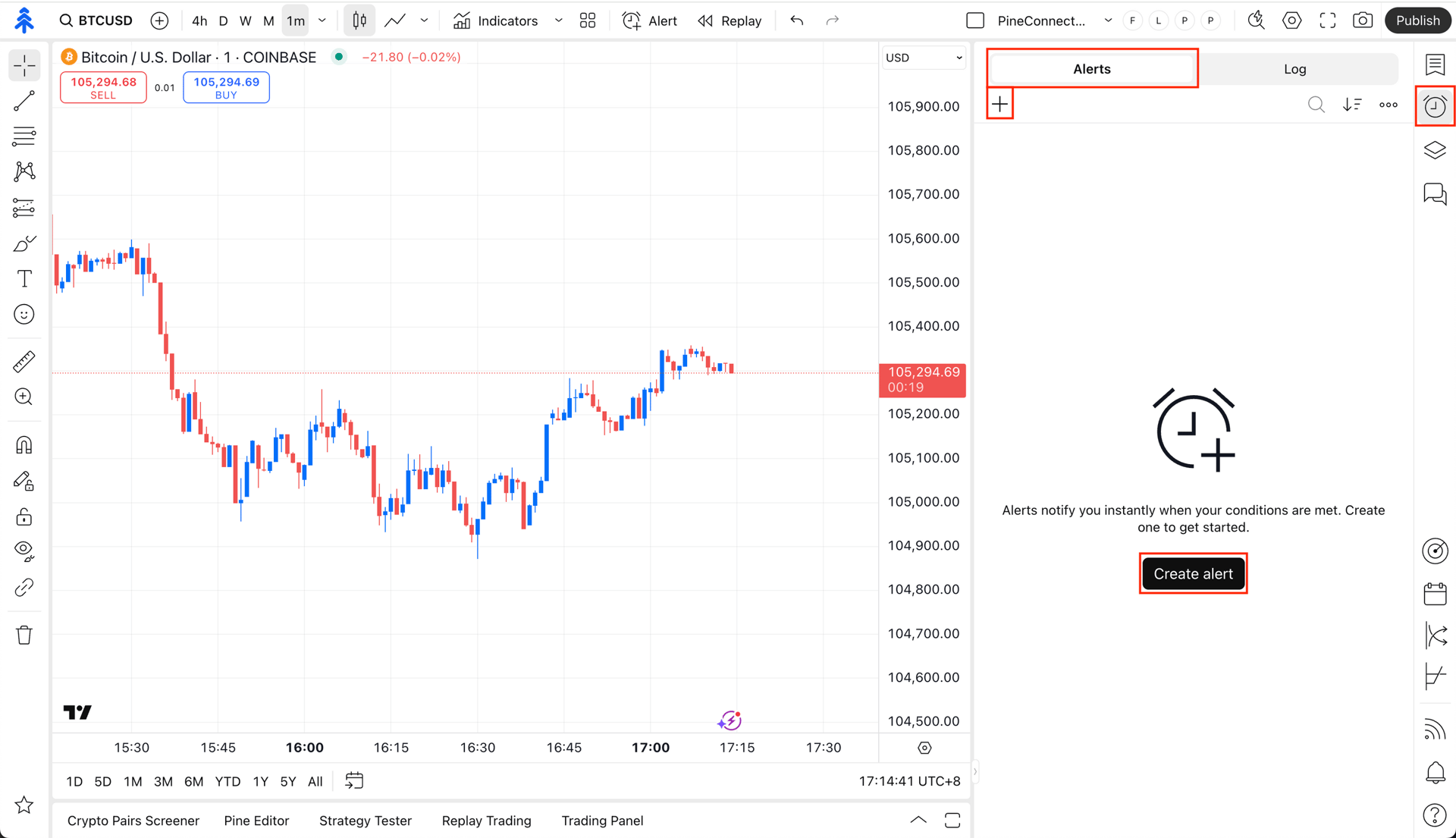
The trigger chart and the order symbol are separate. A BTCUSD chart can trigger the fixed EURUSD message above. Keep the broker symbol in the message; do not replace it with a chart-ticker placeholder for this test.
A 24/7 chart can receive quotes while your broker’s EURUSD session is closed. You need both a working trigger chart and an open broker trading session to expect the complete demo test to finish.
4. Configure the temporary alert
Section titled “4. Configure the temporary alert”Settings: Greater Than 0, only once
Section titled “Settings: Greater Than 0, only once”Set these fields in Settings:
| Field | Value for this test |
|---|---|
| Condition | Price |
| Operator | Greater Than |
| Value | 0 |
| Trigger | Only Once; some layouts call this Once only |
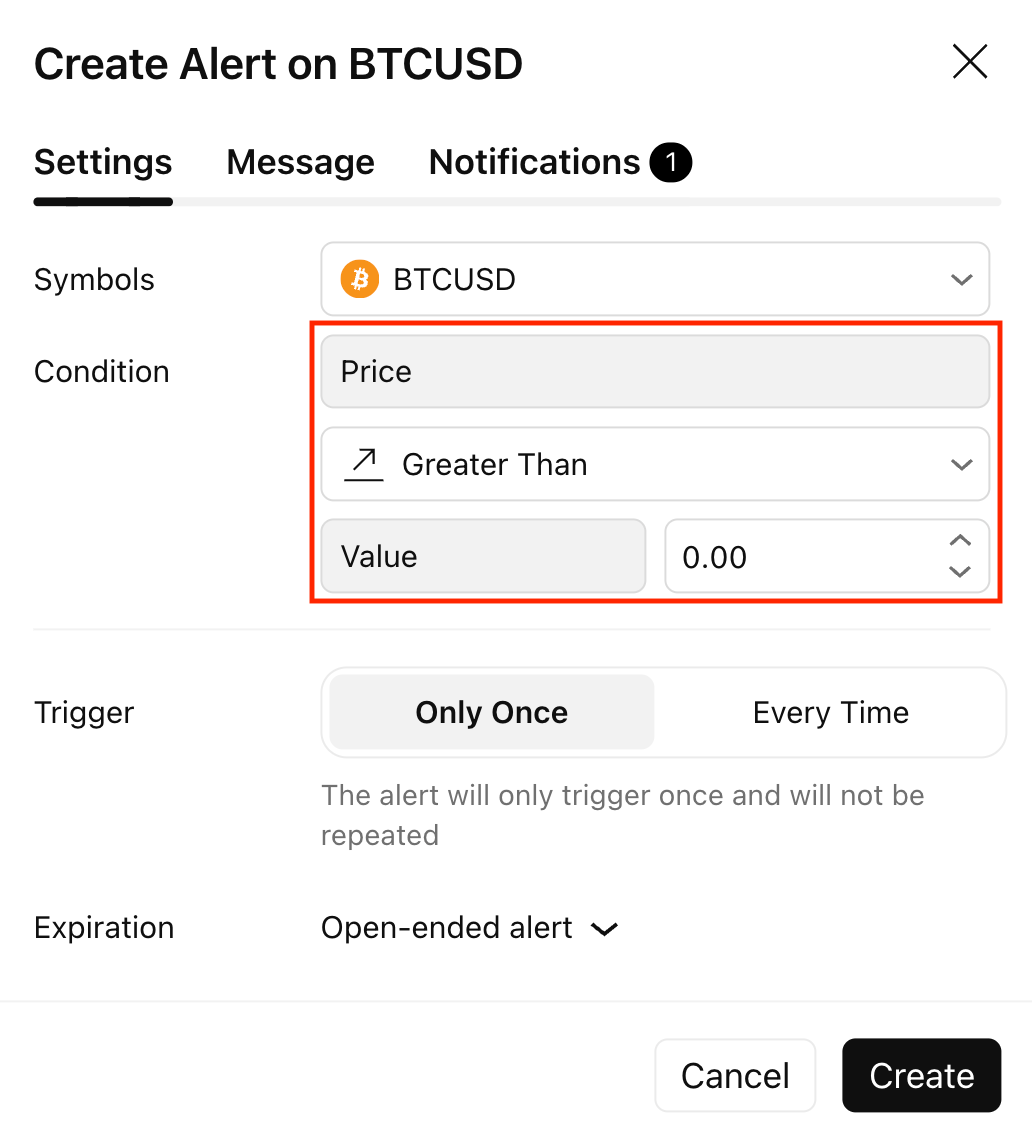
With a positive live quote, the condition is already satisfied, so the test should trigger on the next eligible price update. It is not a guarantee of an instant notification: no incoming quote, a closed chart session or delivery delays can prevent an immediate result.
Choose Greater Than here. Crossing waits for the price to cross the level and is unsuitable for this zero-threshold test. Keep this as a temporary setup test, not a strategy condition. TradingView explains its operators and one-time price-alert frequency.
Message: paste the reviewed buy instruction
Section titled “Message: paste the reviewed buy instruction”- Open Message. Depending on your TradingView layout, this is a tab or a button opening Edit message.
- Name the alert Demo trade test so you can find it later.
- Paste your complete reviewed buy message into Message.
- If the editor has an Apply button, select it to return to the alert settings.
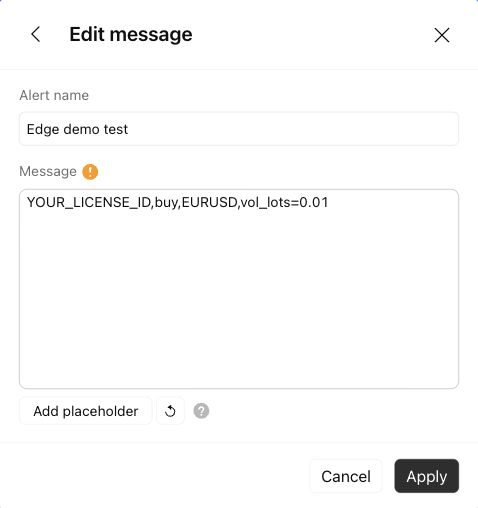
Before continuing, read the actual message: correct License ID → buy → exact broker symbol → intended volume. Add the matching authentication secret only if it is enabled.
Notifications: enable the webhook
Section titled “Notifications: enable the webhook”Open Notifications, tick Webhook URL, and paste this address:
The webhook goes in Notifications; the trading instruction stays in Message.
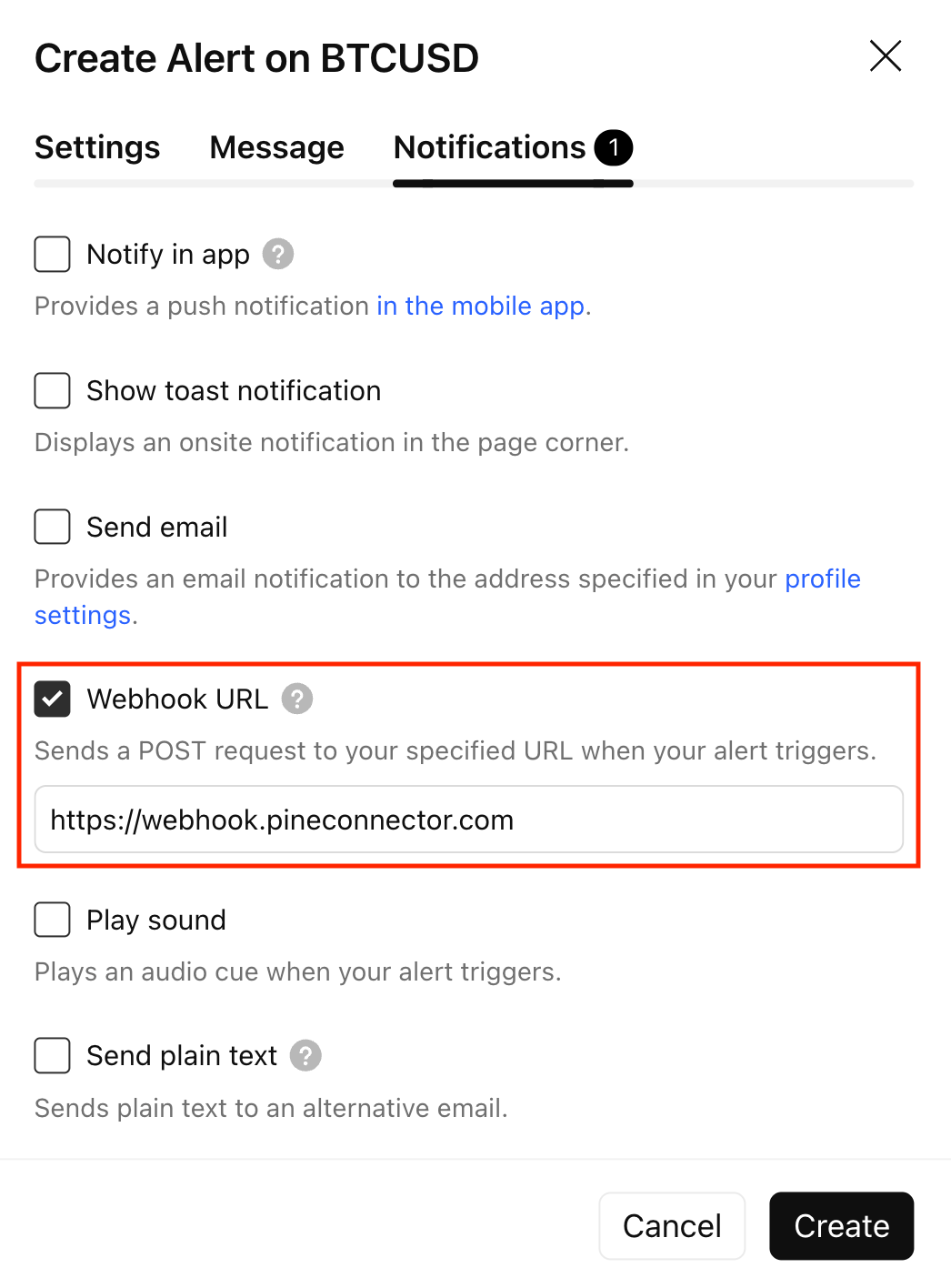
Select Apply if your layout uses it. Webhook access must be available on your TradingView plan and two-factor authentication must be enabled.
Review and create
Section titled “Review and create”Recheck the demo account group, exact message, Greater Than 0, Only Once and webhook URL. Then select Create once.
Keep one trade-test alert active. Do not create several copies while waiting for a result; a later trigger could produce extra orders.
5. Check TradingView’s Alerts log
Section titled “5. Check TradingView’s Alerts log”Open Alerts → Log and find Demo trade test. Confirm its time and the actual message that fired.
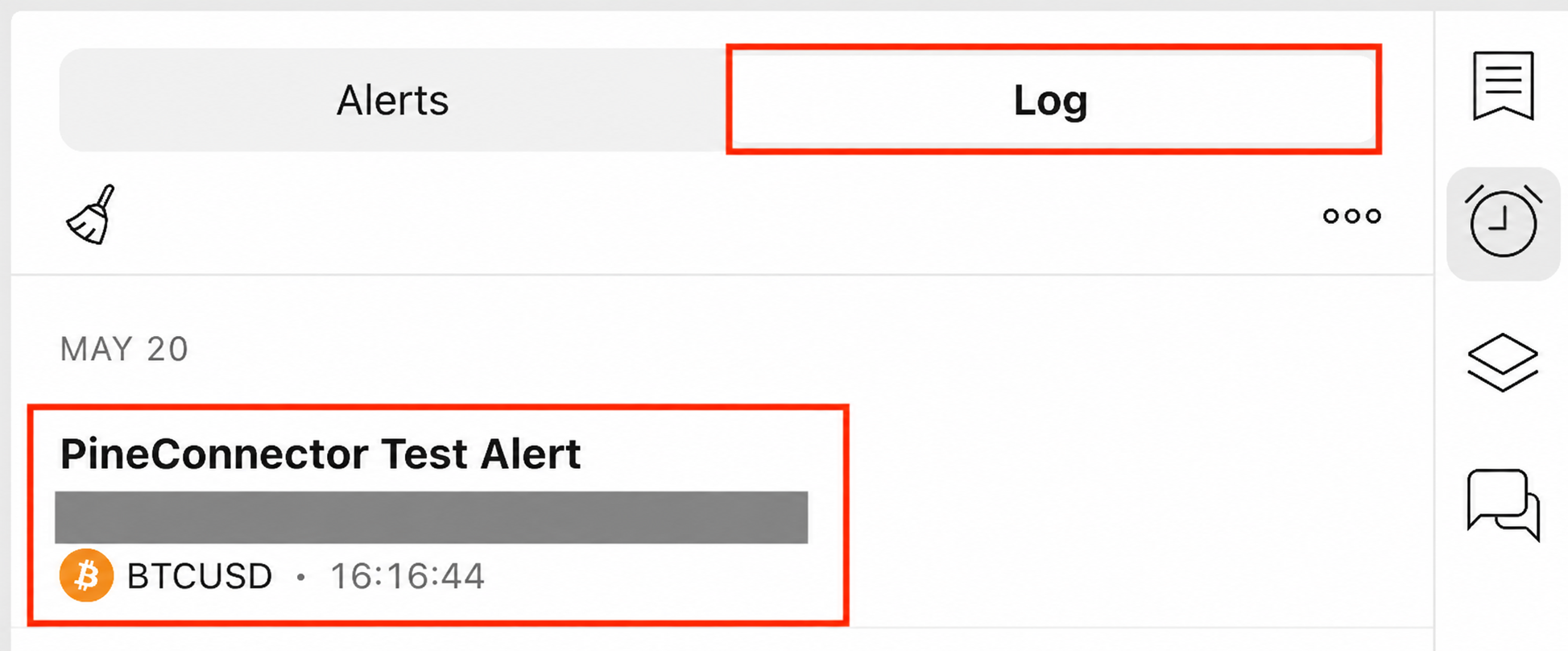
A one-time alert stops after it fires. If you see Stopped — Triggered, that can be the expected one-time state, not a failure.
If no event appears, first check that the chart is receiving live positive quotes and that the operator and trigger are correct. TradingView has not sent the message merely because you clicked Create.
6. Confirm processing in Bridge
Section titled “6. Confirm processing in Bridge”- Open PineConnector Portal → Bridge.
- Find the new entry using the alert time and intended account.
- Open its details and compare the message, symbol, action and processing result.
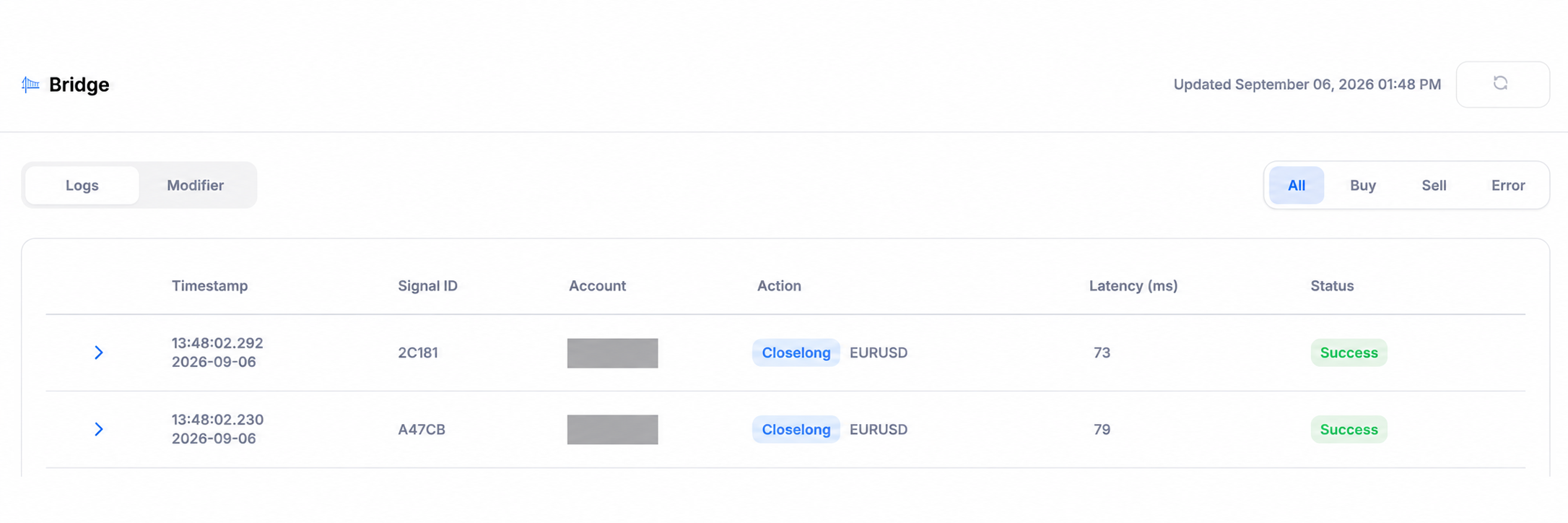
If the message is missing or rejected, follow Missing signals or the matching EA error. A successful processing record is one checkpoint; still confirm the actual trade at the broker.
7. Confirm the trade in the broker account
Section titled “7. Confirm the trade in the broker account”Open the same broker account in its supported MT5 mobile app, web terminal or desktop terminal. Open its Trade/positions view. On desktop MT5, the Trade tab is in the lower Toolbox panel.
| Check | Expected for the unchanged example |
|---|---|
| Account | The intended demo account, not another account sharing the ID. |
| Symbol | The exact broker symbol you put in the message. |
| Direction | Buy. |
| Volume | 0.01 lots, unless you deliberately changed it to a permitted value. |
| SL / TP | None from this test message. |
| Duplicates | No unexpected additional order. |
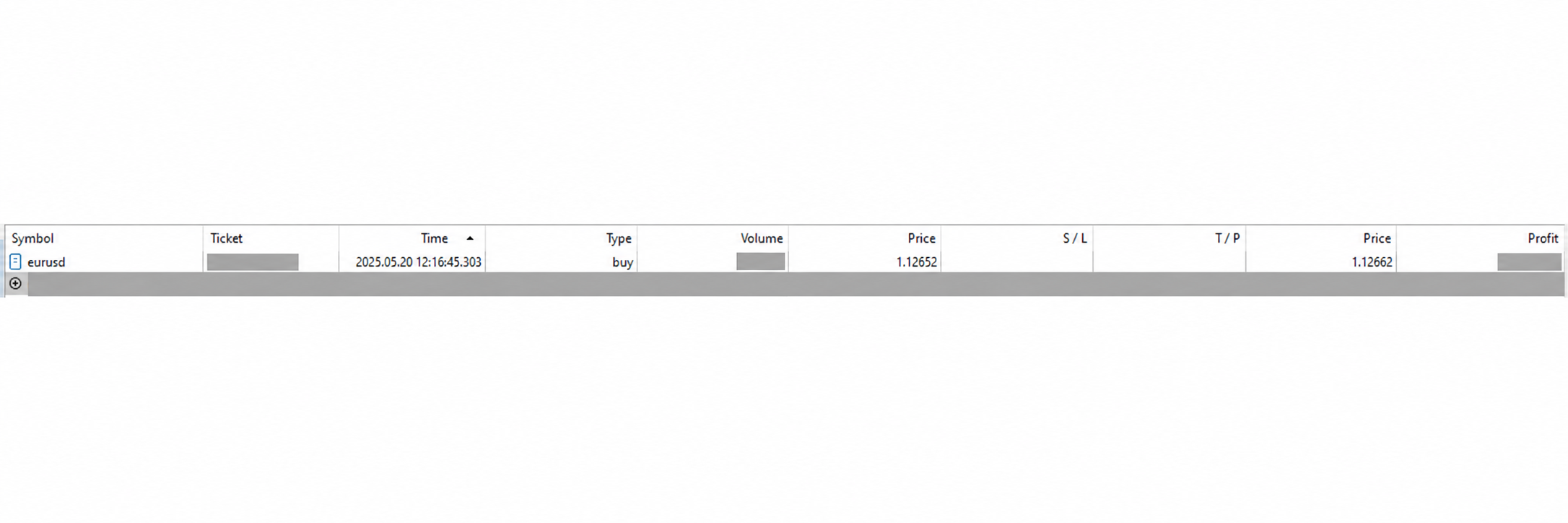
If an order is missing, inspect Experts and Journal at the matching time. On Edge, select your instance in Portal → Edge to read both logs in your browser. For a self-hosted terminal, open the tabs in MT5. Check the intended broker account’s positions and history before repeating a trading command.
Before retrying, check the account for an existing order. A delayed notification is not proof that the first request failed.
8. Finish the test
Section titled “8. Finish the test”Close the demo position through your broker interface, then disable or delete the temporary TradingView alert.
You are ready for the next stage when the intended TradingView alert was matched to its processing record and the expected broker trade, with no unintended duplicate.
Optional reference
Section titled “Optional reference”Additional checks
Can I send the connection-test message from TradingView instead?
Yes. Follow the same one-time alert procedure above, using the message below instead of the buy message. Name it Connection test.
Match the event in TradingView and Bridge, then remove the temporary alert. This checks message delivery from TradingView; it does not verify a broker order.
Link to this answer